Hard work does pay off
Start with the part of the saying that holds. A meta-analysis published in 2015 pooled 28 controlled studies of healthy adults (723 people). Compared with no training, continuous moderate endurance training raised maximal oxygen uptake (VO2max) by an average of 4.9 ml/kg/min, and high-intensity interval training by 5.5 ml/kg/min. The gap between the two is small but favours intervals: 1.2 ml/kg/min. Hard sessions have their place, but steady moderate training also brings most of the gain.
Hard work has a cost too. According to a 2011 review of 33 studies, the pleasure people take in exercise drops once intensity passes the "threshold" (the pace at which breathing quickens sharply and lactate starts to build up): below it, exercise is pleasant for most people; above it, unpleasant for almost everyone. When people choose the intensity themselves, they tolerate harder efforts better. The authors argue that exercise guidelines should consider this pleasure, not only effectiveness.
Piling up pain: overreaching
Does more load always bring more gain? In a study published in 2014, 23 of 33 trained male triathletes did a 3-week block of heavy training while 10 kept training normally; then everyone cut back their load for 4 weeks. By the end of the heavy block, 11 of the 23 were "functionally overreached": their performance had dropped and their fatigue did not lift. The other 12 were only tired; their performance had not dropped.
After the taper, the group that improved most was the one that did the heavy block without overreaching. The overreached athletes improved no more than those who had trained normally. Of the 10 infections reported during the study, 7 were in the overreached group, 2 among the merely tired and 1 among those training normally. We covered the link between heavy load and infection in our article on getting sick after a long race.
Endurance sport has a name for the balance: "polarised" training, where most sessions are very easy, a few are very hard and little is in between. In a 9-week study that randomly split 48 runners, cyclists, triathletes and cross-country skiers into four groups, the polarised group improved most (VO2max up 11.7%); the groups training at threshold or with high volume showed no further gains in the measures. The evidence is thin, though: a 2019 meta-analysis could pool only 3 studies comparing polarised with threshold training, with a moderate effect in favour of polarised.
All the way to failure?
In the weight room the saying becomes "until the last rep". A 2022 meta-analysis of 15 studies (all in young adults) found that taking sets to failure made no significant difference to strength or muscle size compared with stopping short. A broader 2024 analysis found strength gains nearly independent of how close sets go to failure, while muscle size grows slightly more the closer they get; the authors stress that the exact relationship is still unclear.
Next-day muscle soreness is not a measure of progress either. According to a 2013 review, soreness shows that the muscle met a load it was not used to; it does not show how much it adapted. That is a review article, not a clinical trial.
Training through pain: a yes with limits
In rehabilitation the picture is more nuanced. A 2017 meta-analysis pooled 7 randomised controlled trials with 385 people with chronic musculoskeletal pain: exercise in which pain was allowed or encouraged made a small difference over pain-free exercise in the short term; in the medium and long term there was no difference. According to the authors, pain during exercise need not stand in the way of recovery.
In a 2007 trial with 38 patients with Achilles tendinopathy, one group kept running and jumping under a pain-monitoring model, that is, as long as pain stayed below a set limit; the other group stopped those activities for the first 6 weeks. Over 12 months of follow-up both groups recovered equally well: no harm from continuing could be shown. The message is not "push through the pain" but "you can keep training with measured pain".
Athletes have a particular difficulty here: according to a meta-analysis of 15 studies (899 people), athletes tolerate pain markedly better than active people who are not athletes. Bearing pain for longer also means hearing the warning later.
Silencing pain with pills
In a study of 3,913 runners at the Bonn marathon and half marathon in 2010, 49% had taken painkillers before the race. Side effects during or after the race were reported by 16% of those who had taken painkillers and 4% of those who had not, and the risk rose with the dose. All 9 people admitted to hospital had taken painkillers: 3 with temporary kidney failure, 4 with bleeding, 2 with heart attacks. The authors saw no clear benefit from the painkillers either.
Our data: spending the pain early in a race
Race day asks the same question: does pushing to the limit in the first half pay off? We looked at the 26 road courses on this site with a timing point at halfway: 21 races, 49,927 finishes. For every finisher we compared the pace of the second half with the pace of the first.
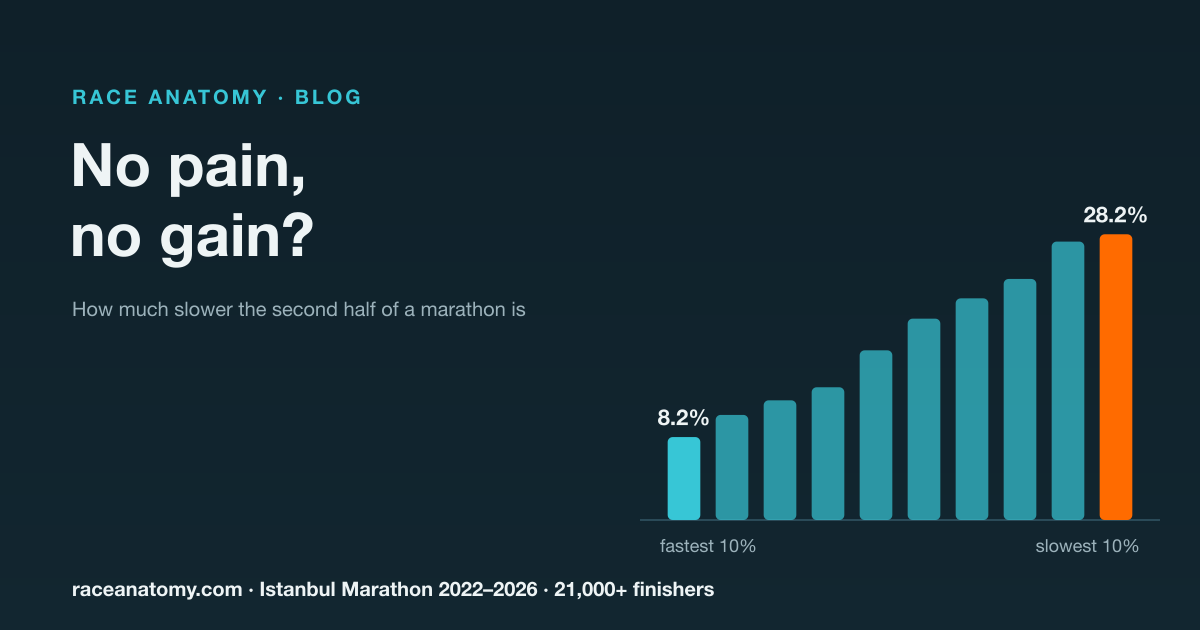
In the marathon the data come from 5 editions of the Istanbul Marathon (2022–2026, 21,211 finishers): on average the second half was run 18.1% slower than the first. But not everyone slows the same. By finishing time, the fastest tenth slowed by 8.2% on average, the slowest tenth by 28.2%. In the half marathon (9 courses, 13,624 finishers) the same two figures are 2.0% and 14.3%; over 10K, 3.7% and 8.6%.
Deaner and colleagues count a runner whose second half was less than 10% slower than the first as having held their pace, and one who slowed by 30% or more as having slowed markedly. In the Istanbul Marathon, 32.8% of finishers held their pace and 18.1% slowed markedly. From halfway to the finish, those who held their pace passed a net 9 runners per 100 in the field on average; those who slowed markedly were passed by 15.
There is a difference between women and men as well: in the marathon, women slowed by 13.6% in the second half and men by 19.2%. Looking at 91,929 finishes in 14 US marathons in 2011, Deaner and colleagues found the same pattern (women 11.7%, men 15.6%); March and colleagues showed that faster, older and female runners hold their pace more evenly.
These data do not show cause and effect. Slower finishers slow more not only because they pushed too hard early; less training, heat or the course profile can do the same. What we can see is this: the front of the field runs more evenly than the back, and a runner who fades in the second half does not carry their halfway position to the finish.
| Distance | Finishers | Average slowdown | Fastest → slowest tenth |
|---|---|---|---|
| 10K · 12 courses | 15,092 | 5.5% | 3.7% → 8.6% |
| Half marathon · 9 courses | 13,624 | 6.0% | 2.0% → 14.3% |
| Marathon · 5 courses | 21,211 | 18.1% | 8.2% → 28.2% |
The studies at a glance
| Study | Who | Finding |
|---|---|---|
| Silbernagel 2007 | Achilles tendinopathy, 38 patients | No harm shown from continuing to run while monitoring pain |
| Ekkekakis 2011 | Review, 33 studies | Pleasure drops above the threshold |
| March 2011 | 319 marathoners | Faster, older and female runners hold their pace more evenly |
| Tesarz 2012 | Meta-analysis, 15 studies | Athletes tolerate more pain |
| Küster 2013 | Bonn 2010, 3,913 runners | Side effects: 16% with painkillers, 4% without |
| Schoenfeld & Contreras 2013 | Review | Soreness is not a measure of progress |
| Aubry 2014 | 33 triathletes | The overreached improved no more than normal training; 7 of 10 infections were theirs |
| Stöggl & Sperlich 2014 | 48 endurance athletes, 9 weeks | Largest gains in the polarised group |
| Deaner 2015 | 14 marathons, 91,929 finishes | Second-half slowdown: men 15.6%, women 11.7% |
| Milanović 2015 | Meta-analysis, 28 studies | VO2max gain: intervals 5.5, continuous 4.9 ml/kg/min |
| Smith 2017 | 7 trials, 385 people | Painful exercise slightly ahead short term, no difference long term |
| Rosenblat 2019 | Meta-analysis, 3 studies | Moderate effect in favour of polarised; little evidence |
| Grgic 2022 | Meta-analysis, 15 studies | Training to failure made no significant difference to strength or muscle size |
| Robinson 2024 | Meta-regression | Strength nearly independent of proximity to failure; muscle size rises slightly closer to it |
What it means for athletes
The evidence backs half of the saying: there is no progress without effort, and hard training has its place. The pain itself, however, is not a measure of the gain. Hard days work better when easy days are truly easy; if performance drops and fatigue does not lift, more load can bring losses and infections rather than gains. Training on with pain is possible as long as it is measured; silencing pain with painkillers before a race carries serious risks. On race day the data point the same way: it is not the athlete who spends the pain in the first half who moves up, but the one who holds their pace.
This article is not medical advice. For pain that does not go away or keeps getting worse, see a doctor or a physiotherapist.