The first alarm: 2 to 6 times as common after a race
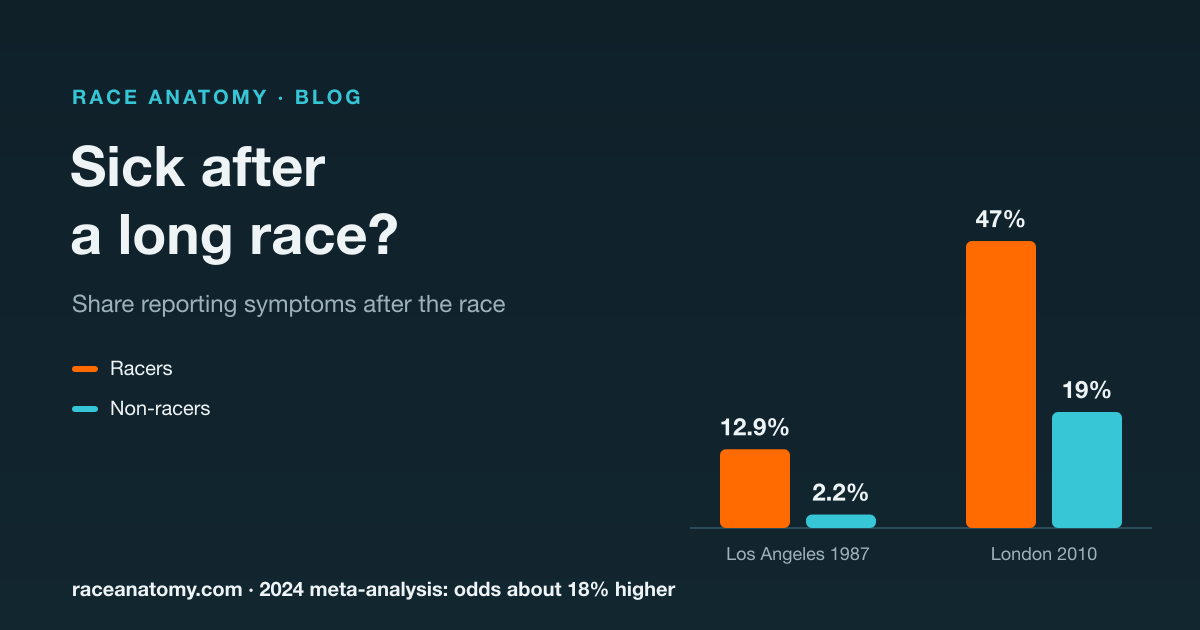
In 1983, runners of the 56 km Two Oceans ultramarathon in South Africa reported upper respiratory symptoms in the two weeks after the race about twice as often as a comparison group that did not run. A few years later, at the Los Angeles Marathon (1987), 12.9% of those who ran reported an infection the following week, against 2.2% of similar runners who had entered but did not start for other reasons.
From these results came the "open window" idea: that after a hard effort the immune system is weakened for a period of hours to days, and germs get in through that gap. Among athletes the idea is still very common.
Then the doubts
In a group of 1,694 runners of the Stockholm Marathon (2000), 17% had an infection in the three weeks before the race and 19% in the three weeks after it. The real difference lay elsewhere: among those who were ill before the race, 33% fell ill again afterwards, against 16% of those who started healthy. The authors concluded that their data do not support the "open window" in recreational runners; the strongest predictors were health before the race and younger age.
Among 208 runners of the London Marathon (2010), 47% had upper respiratory symptoms after the race, against 19% of the non-runners they lived with. But the strongest predictor of symptoms was allergy, and 40% of the runners met the definition of allergy. The authors suggest that part of the "marathon cold" may be allergy or inflammation rather than infection. A study following triathletes and cyclists pointed the same way: a pathogen was found in only 11 of 37 recorded episodes.
Then there is interpretation. According to Campbell and Turner (2018), the drop in immune cells in the blood right after a race is not a collapse: the cells move from the blood into tissues such as the lungs and gut, so the guard changes post. Travel, a crowded start area, a sleepless night and stress all fall into the same window; blaming the infection on the race alone ignores them.
The best answer today: a real but small risk
The most complete answer came in 2024. Sardeli and colleagues pooled 7 studies that compared the same runners before and after a marathon, Stockholm and Los Angeles among them. The odds of an upper respiratory infection after the race were about 18% higher (odds ratio 1.18, confidence interval 1.05–1.33). The studies agree with each other, the quality of evidence is moderate, and the rise is clearest in younger athletes.
That is a much smaller effect than the 2- to 6-fold difference the first studies measured. Nor is the debate closed: in 2020, researchers in the field set out opposing views in a single article and left open whether exercise itself raises the risk. What they agreed on is that infection depends on several factors at once.
| Study | Race or group | Finding |
|---|---|---|
| Peters & Bateman 1983 | Two Oceans, 56 km | In the two weeks after: symptoms about twice as common as in non-runners |
| Nieman 1990 | Los Angeles Marathon 1987 | Infection the week after: 12.9% of runners, 2.2% of non-starters |
| Ekblom, Ekblom & Malm 2006 | Stockholm Marathon 2000, 1,694 runners | 17% before, 19% after; 33% if ill before |
| Spence 2007 | Triathletes and cyclists | A pathogen found in 11 of 37 episodes |
| Nieman 2011 | 1,002 adults, 12 weeks | Exercise 5+ days a week: 43% fewer sick days |
| Robson-Ansley 2012 | London Marathon 2010, 208 runners | Symptoms: 47% of runners, 19% of non-running housemates; allergy the strongest predictor |
| Campbell & Turner 2018 | Review | The drop in immune cells is redeployment to tissues, not collapse |
| Grande 2020 | Review (Cochrane) | Exercise reduces how severe symptoms are and how long they last |
| Simpson 2020 | Debate article | Whether exercise itself raises the risk is unresolved |
| Sardeli 2024 | Meta-analysis, 7 studies | Odds ratio after the race 1.18 (1.05–1.33) |
| Harrison 2025 | Snowdonia Marathon 2017, 406 runners | High anxiety before the race: odds ratio 3.2 |
The mind before the race
A study published in 2025 followed 406 runners of the Snowdonia Marathon (2017) for two weeks before and after the race; 50 had a respiratory infection afterwards. Runners with high anxiety before the race had an odds ratio of 3.2, those with the greatest mood disturbance 3.3. Anxious athletes also showed a larger drop in salivary immunity (IgA), but that drop did not explain the infection risk. It is an observational study: it says anxiety goes with the risk, not that it causes it.
Regular exercise protects
None of this means regular exercise is bad for immunity. In a study that followed 1,002 adults for 12 weeks, those who exercised at least 5 days a week had 43% fewer days with an upper respiratory infection than those who were largely sedentary. According to the 2020 Cochrane review, exercise reduces how severe symptoms are and how long they last; whether it reduces the number of infections is unclear.
What it means for an athlete
The evidence today says: in the week or two after a long race the risk of infection rises a little, but how much of that comes from the race itself and how much from the week around it (travel, crowds, poor sleep, anxiety) cannot be separated. The strongest sign comes before the race: in Stockholm, runners who came to the start line ill fell ill after the race twice as often as those who started healthy (33% and 16%).
This article is not medical advice. See a doctor for fever, chest pain or symptoms that do not go away.