First, ATP: three ways to renew it
The energy for muscle contraction comes from a molecule called ATP. The ATP store in a muscle cell is small, so it has to be renewed as it is used; in intense exercise the demand for ATP can rise up to 1,000 times the resting rate. The body renews ATP in three ways: from phosphocreatine in the muscle, from breaking down glycogen or glucose without oxygen (glycolysis), and from oxygen-based production in the mitochondria. Oxygen-based production burns both carbohydrate and fat.
These three pathways do not switch on and off one after another: in almost every effort all three work together, only their shares change. What mainly sets the shares is how hard and how long the effort is. In the diagrams below the arrows show the path the fuel takes; several sources can contribute at the same time.
Resting between meals
- Brain
- Main fuelBlood glucose
- Store broken downLiver glycogen
- Liver makes glucoseLactate and glycerol
- Main fuelBlood glucose
- Resting muscle
- Blood glucose
- Fatty acids carried in bloodFat tissue
↑ means the fuel flows into the box above.
A few hours after a meal, the liver supplies the glucose in your blood: partly by breaking down its glycogen store, partly by making new glucose from substances such as lactate and glycerol. The biggest user of this glucose is the brain. The brain is about 2% of body weight, yet at rest about 20% of the energy the body uses goes to it. Its main fuel is glucose; when glucose runs low it can use ketone bodies, and during exercise it can also use lactate.
Resting muscle is less choosy: it can use glucose from the blood as well as fatty acids carried in the blood from fat tissue.
When you suddenly sprint
- Muscle contraction
- ATP in the muscle cell
- Fast ATP renewalPhosphocreatine in muscle
- GlycolysisMuscle glycogen
- Oxygen-based productionMitochondria
- ATP in the muscle cell
↑ means the fuel flows into the box above.
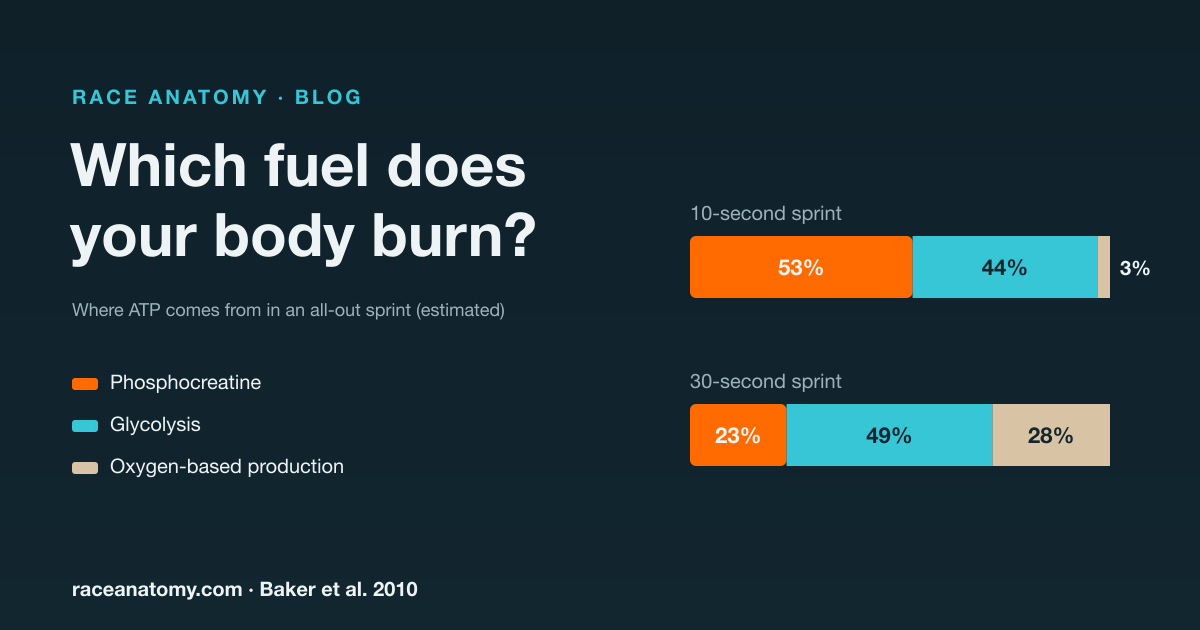
In the first moment of a sprint, the fastest way to renew ATP is phosphocreatine in the muscle. But the store is small: it leads only for about the first 6 seconds of an all-out effort. Glycolysis starts within the first seconds too, and oxygen-based production contributes from the start; as the effort gets longer, both take a bigger share.
| Sprint | Phosphocreatine | Glycolysis | With oxygen |
|---|---|---|---|
| 10 seconds | 53% | 44% | 3% |
| 30 seconds | 23% | 49% | 28% |
In an all-out effort, the point where the pathways without and with oxygen contribute equally lies between 1 and 2 minutes, most likely around 75 seconds. So even a short sprint is not entirely "anaerobic".
Phosphocreatine runs out fast but also refills fast. Right after a 30-second sprint only 19.5% of the muscle's phosphocreatine was left; it was back to 65% after 1.5 minutes of rest and to 85.5% after 6 minutes. That is why the length of the rest matters in repeated sprints.
On a long, easy bike ride
- ATP
- Working muscle
- Blood glucose and lactate
- Absorbed and processedGel or sports drink
- Blood glucose
- Store broken downLiver glycogen
- Liver makes glucoseLactate and glycerol
- Fatty acidsFat tissue
- Muscle glycogen
- Fat inside the muscle
- Blood glucose and lactate
- Working muscle
↑ means the fuel flows into the box above.
At an easy pace, working muscle uses its own glycogen, glucose from the blood and fatty acids together. The release of fat from fat tissue into the blood is highest at low intensity. In a 2-hour effort at 65% of maximal oxygen uptake, the share of fuels coming from the blood rose over time, while the share of the muscle's own glycogen and of fat stored inside the muscle fell.
What does the carbohydrate you take on the bike protect? In one study 14 cyclists rode for 3 hours at 50% of their peak power while taking 1.7 grams of glucose or sucrose per minute. Liver glycogen was preserved, but muscle glycogen still fell by about 41%. In an extra trial with water only (4 cyclists), liver glycogen fell by about 38% as well. In other words, the carbohydrate you take on the ride protects the liver's store; the muscle still spends its own glycogen.
The type of carbohydrate changes the path too. In an experiment where 7 endurance athletes exercised for 120 minutes at about 60% of their maximal oxygen uptake, adding 0.8 grams of fructose to 1.2 grams of glucose per minute raised the rate at which lactate was burned by about 31% compared with the same amount of glucose alone, and more glucose entered the blood. Part of the fructose is first turned into lactate and part into glucose before being burned; that is what the "blood glucose and lactate" box in the diagram shows.
According to a review, taking more than 1.5 grams of carbohydrate per minute at moderate intensity can prevent liver glycogen from running out, and in efforts longer than 90 minutes the liver's store plays a part in performance. To reduce stomach trouble, glucose is recommended together with fructose or sucrose. After exercise, taking glucose together with fructose or galactose can double the rate at which liver glycogen refills.
When the same ride hits a steep climb
- ATP
- Production speeds upWorking muscle
- The muscle's own storeMuscle glycogen
- Carbohydrate via the bloodBlood glucose
- Fatty acidsFat tissue and fat inside the muscle
- Production speeds upWorking muscle
↑ means the fuel flows into the box above.
When you raise the power, the muscle's need for ATP rises and the fuel mix shifts toward carbohydrate: the higher the intensity, the more glycogen the muscle burns and the more glucose it takes from the blood. The release of fatty acids from fat tissue into the blood falls as intensity rises; fat stored inside the muscle is broken down mainly at higher intensities. Fat keeps contributing, but its share shrinks.
In most Olympic events carbohydrate is the main fuel for production both without and with oxygen. On a long race, climbs, attacks and the final sprint lean on the carbohydrate store as well.
In short
At rest the brain relies on glucose, muscle on glucose and fat. Phosphocreatine carries the first seconds of a sprint, but glycolysis and oxygen-based production are there from the start. In a long, easy effort fat and carbohydrate burn together, and the carbohydrate you take protects the liver's store. As the pace rises, carbohydrate's share grows.
This article is not medical or nutrition advice; for a personal fueling plan, talk to a specialist.
Sources
| Study | Topic or group | Finding |
|---|---|---|
| Romijn et al. 1993 | 5 athletes, three intensities | Higher intensity: more glycogen and blood glucose burned, less fatty acid released into the blood |
| Gastin 2001 | Review: energy systems in maximal exercise | Equal share without and with oxygen: about 75 s |
| Baker, McCormick & Robergs 2010 | Review: energy systems in intense exercise | Phosphocreatine share in an all-out sprint: 10 s 53%, 30 s 23% |
| Lecoultre et al. 2010 | 7 athletes, 120 min | Adding fructose to glucose raised lactate burning by about 31% |
| Gonzalez et al. 2015 | 14 cyclists, 3 hours | Carbohydrate protected the liver; muscle glycogen fell by about 41% |
| Gonzalez et al. 2016 | Review: liver glycogen | More than 1.5 g of carbohydrate per minute can protect the liver's store |
| Hargreaves & Spriet 2020 | Review: muscle metabolism in exercise | ATP store is small; intensity and duration set the pathway shares; carbohydrate is the main fuel in most Olympic events |
| Maldonado & Alsayouri 2023 | Brain physiology | 2% of body weight, 20% of resting energy; main fuel glucose |