2026: first results
Three of the 2026 courses are on the site: 117.7 km, 63 km and 14.6 km. The short course results are not complete at the source yet; once they are, 2026 joins every comparison in this article and it is recalculated over 10 editions.
On the long course the men's winner is Vasilii Korytkin (Russia): 10:38:35, 4:10 per km-effort. That ranks 2nd of 10 wins on pace per km-effort (the same pace as the 2023 win; the gap is under a second).
Among women, Tuğçe Karakaya won in 12:13:49 (4:48 per km-effort): the fastest women's win of the series on pace per km-effort. Second: Beyza Güzel (13:11:57).
The field: from 696 to 2,004, then a new balance
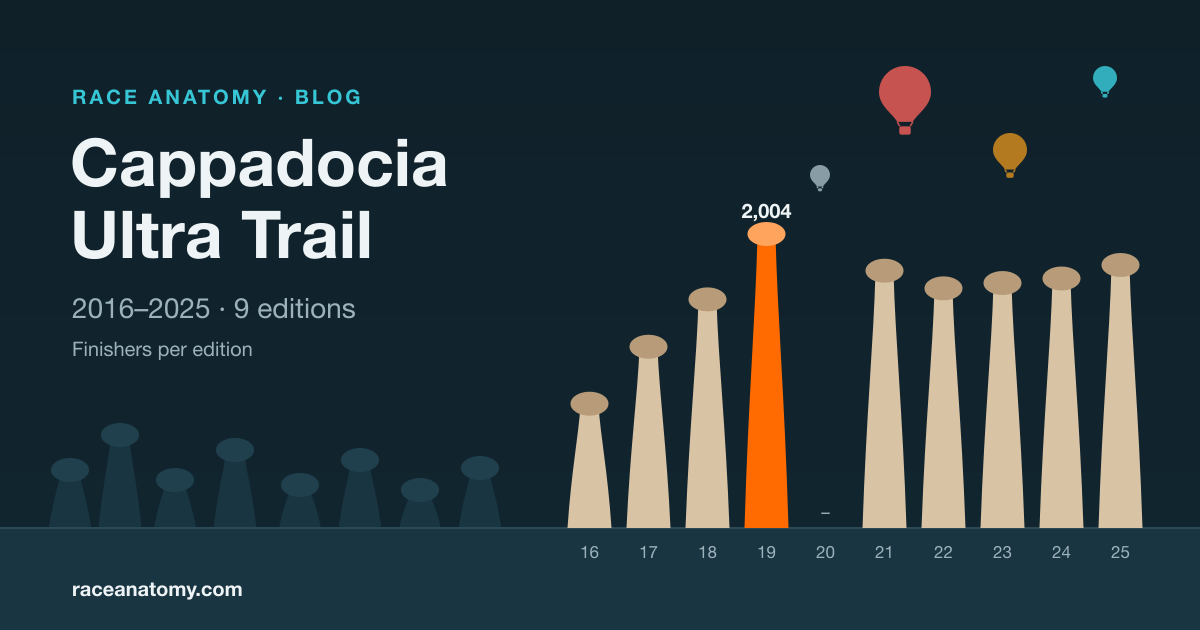
In the first edition (2016), 696 runners finished across three courses. Three years later, in 2019, finishers reached 2,004, 2.9 times as many; that is still the record. There was no race in 2020. Since 2021, finishers have ranged between 1,585 and 1,765.
The 2025 figure needs a footnote: that year a new 15 km course was added, and 473 finishers came from it. On the three classic courses (long, medium, short) the picture is different: 1,292 runners finished them in 2025, the lowest since 2017 and 64.5% of the 2019 peak.
The course is not the same every year
The long course has measured between 116.5 km (2017) and 120.3 km (2021), with total climbing between 3,300 m (2017) and 3,903 m (2021). Comparing finish times from two years directly means comparing two races of different length.
That is why we ranked the winners by pace per km-effort. Km-effort is a common yardstick in trail running: every 100 metres of climbing counts as 1 km (ITRA). The 2025 long course, 118.2 km with 3,721 m of climbing, comes to 155.4 km-effort. Dividing the finish time by km-effort puts winners from different years on the same scale.
The fastest year
Fastest on the clock: Gediminas Grinius (Lithuania), 2017, 10:56:07. But the course was 116.5 km that year. On pace per km-effort the top spot goes to Dmitry Mityaev (Russia, 2023): 4:10 per km-effort. The 2017 win ranks 4th on this list.
Oğuzhan Emre Singer is the only runner to win the long course twice in 9 editions (2022 and 2024). The 2024 win (11:30:23) ranks 3rd on pace per km-effort, the fastest win on this course by a Turkish runner.
Among women, the fastest win on pace per km-effort: Lou Clifton, 2019, 12:41:32 (4:50 per km-effort). Beyza Güzel won the last two editions; those wins rank 4th (2024) and 6th (2025).
| Year | Men's winner | Time | Pace per km-effort | Women's winner | Time | Pace per km-effort |
|---|---|---|---|---|---|---|
| 2016 | Aleksei Tolstenko | 12:13:08 | 4:52 | Anna-Marie Watson | 14:25:49 | 5:45 |
| 2017 | Gediminas Grinius | 10:56:07 | 4:23 | Mariya Nikolova | 14:26:16 | 5:48 |
| 2018 | Andrea Macchi | 11:12:34 | 4:24 | Maria Miteva Nikolova | 13:14:29 | 5:12 |
| 2019 | Noël Yannick | 11:12:07 | 4:16 | Lou Clifton | 12:41:32 | 4:50 |
| 2021 | Diego Pazos | 11:50:22 | 4:28 | Dominika Stelmach | 13:16:12 | 5:00 |
| 2022 | Oğuzhan Emre Singer | 12:20:57 | 4:41 | Ivana Kolaric | 16:23:11 | 6:13 |
| 2023 | Dmitry Mityaev | 10:59:32 | 4:10 | Ekaterina Mityaeva | 13:00:23 | 4:56 |
| 2024 | Oğuzhan Emre Singer | 11:30:23 | 4:22 | Beyza Güzel | 13:40:40 | 5:11 |
| 2025 | Stanislav Sabokar | 12:33:13 | 4:51 | Beyza Güzel | 13:50:32 | 5:21 |
Where do runners drop out?
The share of long-course starters who did not finish ranged from 19.6% (2019) to 33.7% (2023). The toughest year was 2023: of 190 starters, 64 did not finish. The results do not say why; weather or course conditions would need the organiser's records.
Where they stopped, the data does show. We looked at the last checkpoint where each runner was timed. In all 9 editions the most common place to drop out was the same: Ürgüp (tied with another checkpoint in 2019). Ürgüp sits roughly halfway along the course (km 58–64), and it is also where the race is based. Of the 508 runners who dropped out of the long course over 9 editions, 136 (26.8%) stopped there.
Women
On the three classic courses, women made up 26.9% of finishers in 2016 and 30.9% in 2025. On the 15 km course added in 2025 the share was 50.5%. The long course has barely moved: women's share has stayed between 10.0% (2018) and 16.7% (2023); in 2025, 15 women finished it.
The world comes to Cappadocia
Finishers came from 33 countries in 2016; the peak was 71 in 2022, and 62 in 2025. Each year, between 31.2% and 39.8% of finishers came from outside Türkiye. (The 2018 and 2019 results carry no nationality, so those years are left out.)
Loyal runners
Across 9 editions there are 13,693 finishes, belonging to roughly 10,000 different people. 77.8% of finishers have completed Cappadocia only once. At the other end, 5 runners have finished all 9 editions: Hakan Demiröz, Mikail Topcu, Murat Alper Talı, Mustafa Ekseri and Tolga Güler.
The most long-course finishes belong to Cevdet Alyılmaz and Tolga Güler: 8 each.