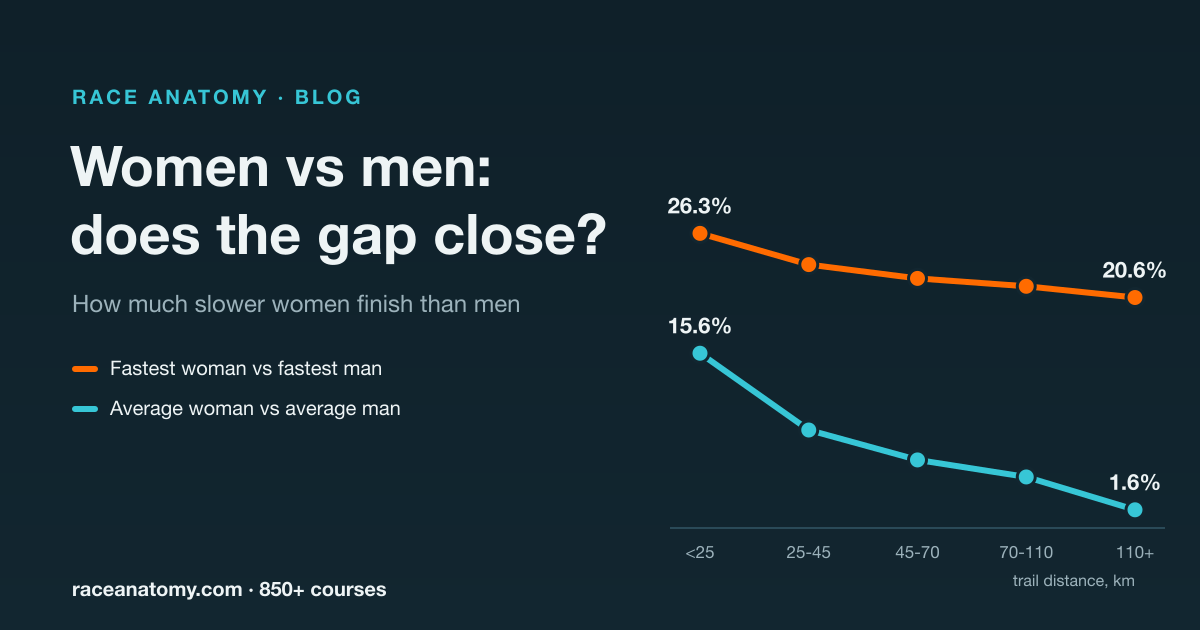
Between winners it stays, on average it closes
You can measure the gap between women and men in a race in two ways: the fastest woman against the fastest man, or the average time of women against that of men. The two measures do not give the same answer.
On trails, the fastest woman's time is on average 26.3% longer than the fastest man's on courses under 25 km, and 20.6% longer over 110 km. It shrinks only slightly with distance. The gap between averages, however, falls from 15.6% under 25 km to 1.6% over 110 km. The fastest 10% of each sex show the same pattern: from 22.9% to 1.9%.
| Distance | Women's share | Winners | Average |
|---|---|---|---|
| Under 25 km | 41.9% | 26.3% | 15.6% |
| 25–45 km | 31.2% | 23.6% | 8.8% |
| 45–70 km | 25.0% | 22.3% | 6.1% |
| 70–110 km | 17.2% | 21.6% | 4.6% |
| Over 110 km | 13.0% | 20.6% | 1.6% |
On the road the pattern runs the same way, over a shorter range of distances: the gap between winners is 21.7% over 5 km and 14.8% in the marathon; the gap between averages is 20.4% over 5 km and 5.8% in the marathon.
| Distance | Women's share | Winners | Average |
|---|---|---|---|
| 5 km | 46.7% | 21.7% | 20.4% |
| 10 km | 33.4% | 18.6% | 16.4% |
| 15 km | 35.1% | 23.5% | 14.7% |
| Half marathon | 20.9% | 20.0% | 8.3% |
| Marathon | 19.8% | 14.8% | 5.8% |
Few women in long races
As distance grows, women's share of finishers falls: on trails 41.9% under 25 km and 13.0% over 110 km; on the road 46.7% over 5 km and 19.8% in the marathon.
That matters when reading averages. The few women who enter a long race may not stand for the same thing as a large field of men: women who choose long distances may be a more selected group. The gap between averages closing while the gap between winners stays put fits that reading.
A results list cannot prove it on its own. To separate how much of the gap comes from the body and how much from who races, you would need to follow the same people in both short and long races.
Who slows down in the second half?
Here we made a comparison that selection affects less: women and men who finished in the same time. We split each course's finishers into ten bands by time and, in each band, looked at the fifth whose second-half pace dropped most against the first half. If women and men slowed down alike, about 20% of each would land in that group.
At every distance women land in this group less often. The difference is largest in the marathon: 5.2% of women, 23.5% of men. It is smallest on trails over 110 km: 17.6% and 19.7%.
| Distance | Women | Men |
|---|---|---|
| 10 km | 15.5% | 21.6% |
| Half marathon | 9.1% | 22.5% |
| Marathon | 5.2% | 23.5% |
| Trail, under 45 km | 10.5% | 24.4% |
| Trail, 45–110 km | 8.8% | 22.5% |
| Trail, over 110 km | 17.6% | 19.7% |
Women in the overall ranking
When women and men start from the same line and share one ranking, is there a woman in the top three? On the road, at least one woman is in the overall top three on 3 of 168 courses; on trails, on 44 of 589. In cycling (35 courses) and triathlon (38 courses): none.